
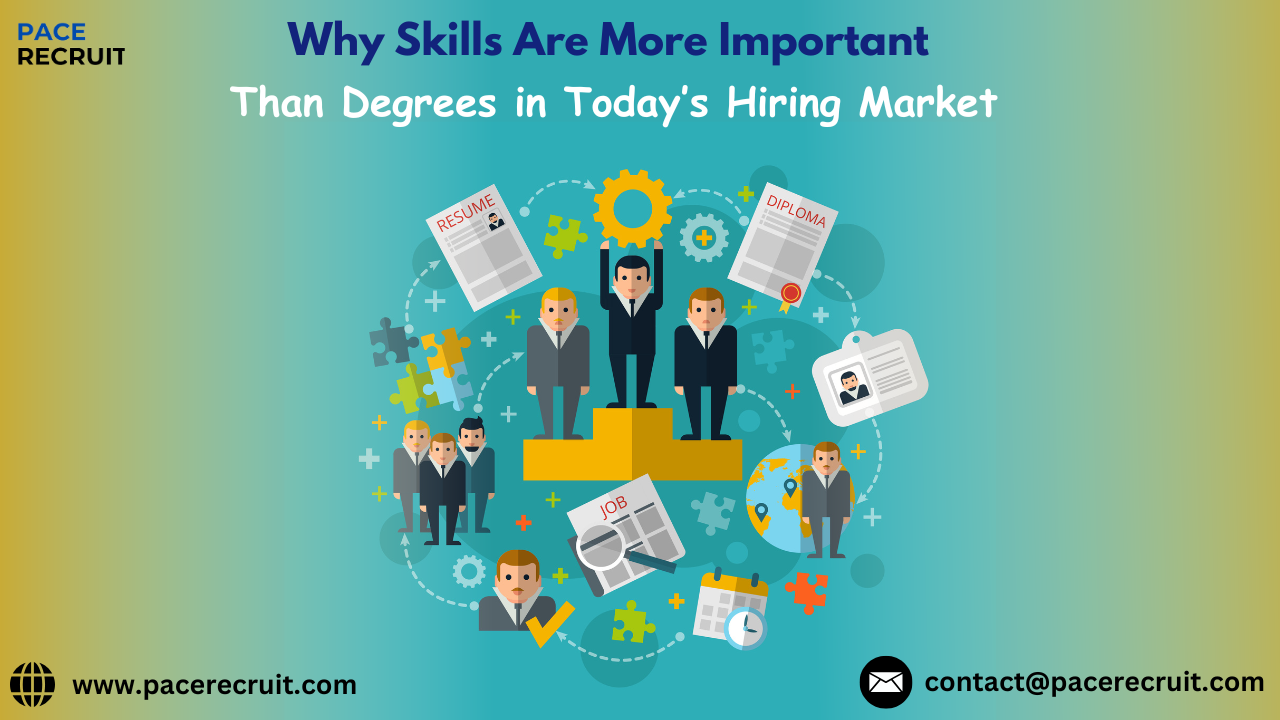
Introduction: A Fundamental Shift in How Employers Define Talent
For a long time, academic degrees have been the holy grail of employability. Employers have traditionally put a lot of stock in formal education as a reflection of intelligence, hard work, and employability. A degree from a top school was often the first—and sometimes only—screen in the hiring process. But the truth in today’s hiring market couldn’t be further from this truth. The rapid evolution of technology, changing business models, and growing skills gap have forced employers to reevaluate how they define talent.
Table of Contents
In today’s skills-driven economy, what the candidate can do is far more important than where they went to school. Employers are finally realizing that degrees don’t necessarily mean anything when it comes to job performance, adaptability, and success. Skills, experience, and the ability to learn and adapt are now the most valuable commodities in the marketplace.
How Traditional Education Is Having Difficulty Adjusting to the Needs of the Workforce
One of the main reasons degrees no longer hold as much importance as they did in the past is that the workforce requirement changes at a gradual and consistent pace. The curriculum at universities and colleges typically has a long lead time of several years for courses to be developed and implemented into their programs. Therefore, industries such as technology, digital marketing, data analytics, and cybersecurity continue to evolve on a regular basis – to be precise, every few months. As a result, by the time a student has graduated from a university, numerous tools. platforms, and frameworks that they had learned will have become dated.
Employers are continuously facing applicants who possess excellent credentials but who, however, do not have experience applying those credentials to real world scenarios. This inconsistency results in extraordinarily prolonged onboarding, high training costs, and low productivity for the company. Therefore, organizations are beginning to seek out employees who can deliver immediate benefit to the business through relevant skill sets.
Skill Obsolescence and Continuous Learning
A significant drawback to utilizing degrees as hiring criteria is that the credentials (i.e., diplomas/certificates) represent completion of learning that occurred in the past. However, skills are not static; they change over time, and therefore, these credentials alone do not provide employers with the necessary insights to assess potential employees. As a result, employers increasingly value employment candidates that can demonstrate a commitment to ongoing education via one or more of the following avenues: certifications, relevant projects, attendance at conferences/workshops, or day-to-day on-the-job experiences. A commitment of this nature is more aligned with modern workforce dynamics, whereby the ability to be adaptive will determine an employer’s ability to thrive or survive.
Skills Are More Important Than Degrees for Today’s Hiring Practices
Performance driven by skills impacts job performance and the ultimate success of a business.
The primary reason why skill sets matter more than a degree today comes down to one major reason…performance. All types of work require specific skill sets (e.g. coding, sales, data, project) to be completed by employees regardless of their level of education (e.g. bachelor’s degree, high school diploma). Employers are becoming less interested in a candidate’s theoretical knowledge and instead are focused on the candidate’s demonstrated ability to successfully perform a job.
In addition to evaluating a potential candidate’s skills, when recruiting for skills first a recruiter looks for a candidate’s ability to solve problems, how they would use their tools, and contribute to the team’s objectives. By doing this, the recruiter is able to potentially decrease their hiring risks and improve retention as the candidate will have a better understanding of what they are expected to be doing from the very first day of work.
When organizations recruit candidates based on skills rather than on credentials they typically will have employees who are operationally ready, therefore, less supervision needed, will be able to learn their new workflows quicker, and produce results faster which makes the organization generally more productive in a competitive environment where being able to produce quickly and efficiently is an important factor in the organization’s success.
How Skills-Based Hiring Expands the Talent Pool for Employers
Breaking free from degree-based limitations
Degree requirements unintentionally exclude a vast pool of capable talent. Many skilled professionals acquire expertise through alternative pathways such as online courses, vocational training, bootcamps, freelancing, or self-directed learning. By removing rigid degree filters, employers gain access to diverse candidates with proven abilities.
This inclusive approach is especially beneficial in industries facing talent shortages. Skills-based hiring allows organizations to tap into non-traditional talent pools, including career switchers, returning professionals, and candidates from underrepresented backgrounds.
Diversity, equity, and inclusion through skills-first recruitment
Focusing on skills rather than degrees also supports diversity and inclusion goals. Not everyone has equal access to higher education due to financial, geographic, or social constraints. Skills-based hiring levels the playing field by evaluating candidates on merit and capability rather than educational privilege.
The Employer Perspective: Why Companies Favor Skills Over Degrees
Cutting down hiring expenses and time, to, fill
The degree, focused hiring approach usually results in longer recruiting periods as employers look for “perfect” academic backgrounds. Skills, based hiring, on the other hand, simplifies this by emphasizing the competencies that are directly relevant to the job. Recruiters can evaluate candidates through skill assessments, portfolios, and live examples.
Making faster and more confident hiring decisions
Workers employed for their skillsets usually have a more precise idea of what their job entails. They have a clue of the task at hand and are capable of facing its difficulties. Such alignment diminishes the number of employees quitting at an early stage and increases the rate of them staying for a long time.
The Candidate Perspective: The Empowerment of Skills-First Recruitment
Degrees are no longer the determinant of career prospects
The candidate perspective on skills-first recruitment is one of empowerment. This is because career advancement is no longer dependent on degrees. Candidates can now focus on developing new skills, change careers, and become more employable by focusing on in-demand skills rather than further education.
This is particularly important for working professionals who cannot afford the time and cost of going back to school. Skill sets, projects, and learning are now given importance in the recruitment process.
Creating employability through experience
Candidates who focus on developing skills are more employable and less at risk in the job market. Even if the candidate changes jobs or industries, skills such as communication, problem-solving, analytical skills, and technical skills are still in demand.
Technology and Its Role in Speeding up Skills, Based Hiring
AI, powered assessments and skill verification
On one hand, innovations in recruitment tech has not only made the process more efficient but also has helped employers assess skills more objectively. AI, powered assessments, coding challenges, simulations, and work, sample tests give a much clearer picture of candidate capabilities than resumes alone. These tools make it easy for recruiters to go beyond educational qualifications and identify true potential.
Making hiring decisions based on data
Another great advantage of skills, based hiring comes from leveraging data analytics. Employers can measure how various skills are associated with employee performance, promotion, and retention. This data, driven method constantly updates and improves hiring strategies, thus making skills, first recruitment more efficient over time.
Examples of Industries Where Skills Are More Important Than Degrees
Technology and IT
When it comes to working in a technology-driven job, skills have historically been valued over formal education credentials. The ability to use programming languages, frameworks, cloud platforms, and security tools is dominant when hiring for these roles, and many of the best employees in the technology field do not possess traditional degrees; instead, they rely on their skill set to perform well in their jobs.
Sales, Marketing, and Business Development
In commercial roles (sales, marketing, business development) performance metrics are generally more important than educational background. Specific skills and/or abilities influence revenue outcomes through direct impact such as negotiating, customer relationship management, digital marketing, and data analysis. Evidence of previous achievements (i.e., sales/success) will help candidates to stand out, even without formal education.
Operations, Logistics, and Supply Chain Management
Operational efficiency depends on the amount of practical knowledge and experience you possess. As such, the knowledge of how to improve process efficiency, manage vendors, and implement technology is much more important than theoretical knowledge in these areas. Employers are increasingly looking for a proven track record of previous experience and the ability to solve problems when making hiring decisions.
How Employers Can Successfully Shift to a Skills-First Hiring Strategy
Rethinking job descriptions in terms of skills
The first thing employers have to do to shift to a skills-first hiring strategy is rethink job descriptions. Employers have to include the skills, equipment, and performance requirements of a job in the job description rather than focusing on educational qualifications.
Training recruiters and hiring managers
Employers have to train recruiters on how to assess skills. This includes training recruiters on how to conduct skill interviews, assess portfolios, and use skill assessment tools. Hiring managers have to be on the same page about what “good” looks like when it comes to skills, not credentials.
How Job Seekers Can Adapt to a Skills-First Hiring Culture
Upskilling in skills that are in demand
Job seekers have to personally identify skills that are in demand in their respective industries and upskill accordingly. Online courses, certifications, workshops, and projects are the best ways to upskill and showcase skills.
Showcasing skills through real-world examples
Job seekers have to go beyond resumes. They have to create portfolios, case studies, and project work that showcase skills. This is the best way to improve the chances of getting a job in a skills-first hiring culture.
PACE Recruit Collaborative: Bridging the Gap between Skills and Opportunities
At PACE Recruit, we are convinced that the core of future hiring will be in spotting actual skills rather than just academic qualifications. We base our recruitment method on a thorough comprehension of the needs of the employers as well as the abilities of the candidates. With the help of our close collaboration with the companies, we are able to find the skills that are needed for those aspects of performance and business that have the greatest impact.
PACE Recruit is the platform that connects professionals with the right job opportunities. This results in faster hiring, better job fit, and higher job satisfaction for both employers and employees. Our commitment to skills, based hiring helps businesses create nimble, future, proof teams while also giving individuals the opportunity to develop based on their actual contributions.
Conclusion: Skills Are the New Currency of the Modern Workforce
The job market is changing at the very core. Academic qualifications still matter, but they have lost their status as the main factor that determines ones employability. It is now skillsthose that are practical, versatile, and continuously updatedthat have become the real standard for talent. Companies that switch to skills, based hiring are able to tap larger talent pools, get better employee performance and higher retention. On the other hand, those that concentrate on skills gain more career options and are better prepared for the unexpected.
When everything around us is constantly changing, it is skills that give us flexibility, something that academic qualifications alone cannot. Those who put a premium on capability rather than just credentials will be the winners in the hiring game of the future.
FAQs
1. Why are skills more important than degrees in todays hiring market?
Skills have a direct effect on work efficiency and performance, however, degrees usually do not illustrate practical skills or the latest industry trends.
2. Are degrees becoming irrelevant in hiring?
Academic qualifications are still important, but they cannot stand on their own as a sufficient condition. Nowadays, employers give top priority to skills even over academic qualifications.
3. How can candidates showcase skills without a degree?
Besides degrees, candidates can also use certificates, portfolios, projects, internships and actual work experience as evidence of what they are capable of.
4. What industries gain the greatest benefits from skills, based hiring?
Technology, sales, marketing, operations, logistics as well as digital roles are the most impacted and thus benefit hugely from a skills, first recruitment approach.
5. In what ways does PACE Recruit help in implementing skills, based hiring?
By centering its efforts on matching candidate skills with the needs of the employers, PACE Recruit not only ensures better job fit but also facilitates faster hiring and long, term success.